Colorado: notices when your hiring or pay software influences a decision, from 2027-01-01
Source read on 2026-11-27 (signed 2026-05-14). This is a template and guide, not legal advice.
Colorado repealed and re-enacted its 2024 AI law in May 2026 (SB 26-189). From 2027-01-01, a business in Colorado that uses software to materially influence a decision about hiring, firing or pay must tell the person up front, explain within 30 days if it went against them, offer human review, and keep records for three years. The Attorney General enforces it.
Who is covered, and from when
Takes effect: 2027-01-01.
“Except as otherwise provided in subsection (2) of this section, this act takes effect January 1, 2027.”
Colorado Senate Bill 26-189, signed act (source), read on 2026-11-27
““Deployer” means a person doing business in Colorado that deploys a covered ADMT.”
Colorado Senate Bill 26-189, signed act (source), read on 2026-11-27
““Covered ADMT” means automated decision-making technology that is used to materially influence a consequential decision.”
Colorado Senate Bill 26-189, signed act (source), read on 2026-11-27
““Consumer” includes an employee, a job applicant who is a Colorado resident, and any individual whose access to, eligibility for, or opportunity in Colorado is evaluated in a consequential decision by a person doing business in Colorado.”
Colorado Senate Bill 26-189, signed act (source), read on 2026-11-27
What an employer must do
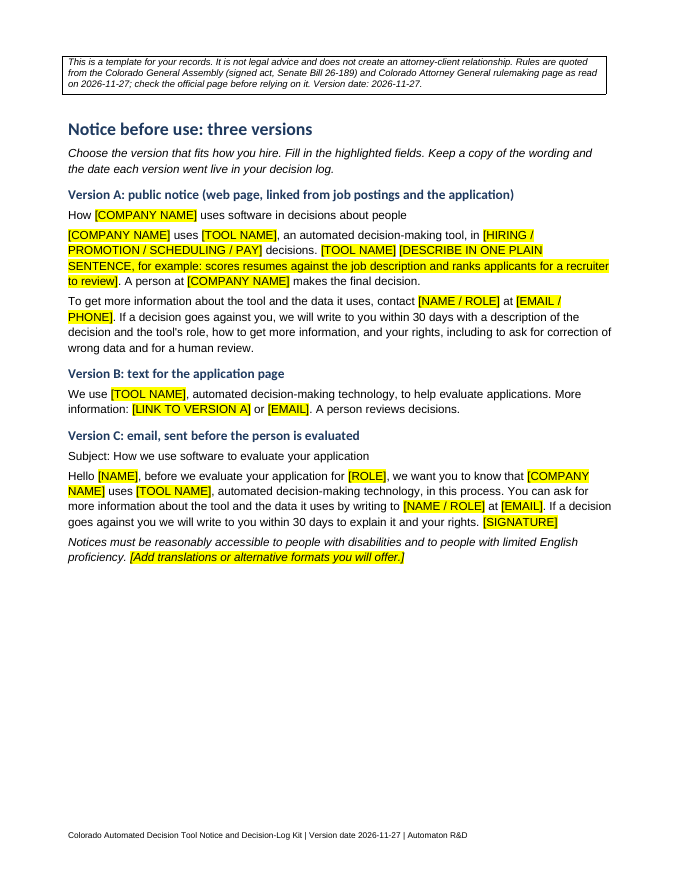
- Before you use the tool on someone: give clear notice that you use or will use it, and how to get more information. A public notice near where the decision happens satisfies this.
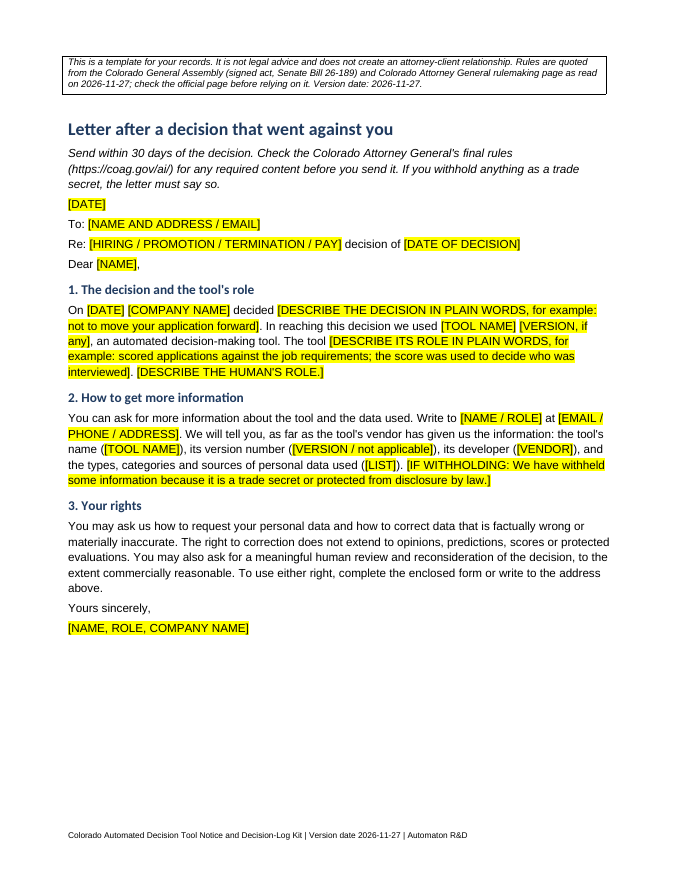
- Within 30 days of a decision that went against the person: describe the decision and the tool's role, say how to ask for more information, and explain their rights.
- On request after an adverse decision: tell them how to correct wrong data and give a human review that is meaningful.
- Keep records showing you complied, for at least three years after the decision.
- Not covered: tools used only to summarise or draft for a human, spreadsheets that need human analysis, and incidental or clerical uses.
“Prior to a deployer using a covered ADMT to materially influence a consequential decision, the deployer shall provide a clear and conspicuous notice to a consumer that the deployer used or will use a covered ADMT in a consequential decision affecting the consumer and instructions regarding how the consumer may obtain the additional information described in this section.”
Colorado Senate Bill 26-189, signed act (source), read on 2026-11-27
“If a deployer uses a covered ADMT to materially influence a consequential decision that results in an adverse outcome for a consumer, the deployer shall provide within thirty days after making the decision: (a) A plain language description of the consequential decision and the role the covered ADMT played in the consequential decision; (b) Instructions and a simple-to-follow process to request additional information about the covered ADMT and the inputs, including the name of the covered ADMT, the covered ADMT version number, if applicable, the covered ADMT developer, and the types, categories, and sources of personal data used, to the extent the deployer receives the necessary information from the developer in compliance with section 6-1-1702; and (c) An explanation of the consumer rights described in section 6-1-1705 and how to exercise them.”
Colorado Senate Bill 26-189, signed act (source), read on 2026-11-27
“A deployer shall retain, for not less than three years after the date of a consequential decision or for a longer period if required by applicable state or federal law, records reasonably necessary to demonstrate compliance with this part 17.”
Colorado Senate Bill 26-189, signed act (source), read on 2026-11-27
What the source does not say
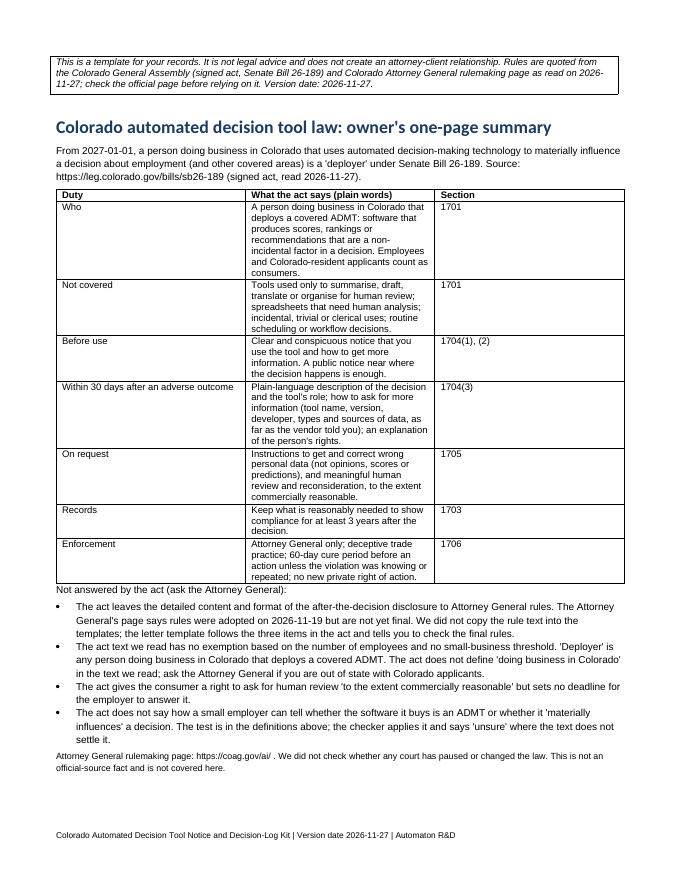
- The act text we read has no exemption based on the number of employees and no small-business threshold. 'Deployer' is any person doing business in Colorado that deploys a covered ADMT. The act does not define 'doing business in Colorado' in the text we read; ask the Attorney General if you are out of state with Colorado applicants.
- The act does not define 'clear and conspicuous' or say exactly where on an application page the notice must sit, beyond the public-notice option 'reasonably proximate' to the interaction.
- The act leaves the detailed content and format of the after-the-decision disclosure to Attorney General rules. The Attorney General's page says rules were adopted on 2026-11-19 but are not yet final. We did not copy the rule text into the templates; the letter template follows the three items in the act and tells you to check the final rules.
- 'Adverse outcome' covers a decision that denies, terminates, revokes, or materially reduces access to or compensation for an opportunity. The act does not list examples for hiring. A rejected applicant, a termination and a pay cut are the plain readings; whether a lower-ranked-but-interviewed applicant is covered is not answered in the text.
- The act does not say how a small employer can tell whether the software it buys is an ADMT or whether it 'materially influences' a decision. The test is in the definitions above; the checker applies it and says 'unsure' where the text does not settle it.
- The act gives the consumer a right to ask for human review 'to the extent commercially reasonable' but sets no deadline for the employer to answer it.
- We did not check whether any court has paused or changed the law. This is not an official-source fact and is not covered here.
- The act has separate rules for insurers, banks and credit unions, HIPAA covered entities, creditors and schools (FERPA). The kit is written for an employer using such a tool in hiring or managing staff; an entity in those groups should read sections 6-1-1704 and 6-1-1708 of the act.
Does this apply to my business? (free check, about one minute)
The check runs in your browser and sends nothing anywhere. It applies the act's definitions; it is not a legal opinion.
What the state gives away free
- SB 26-189, bill page with the signed act (Colorado General Assembly)
- SB 26-189, signed act (PDF)
- Colorado Attorney General: ADMT and Chatbot Safety rulemaking page (draft, interim and adopted rules, hearing record)
The kit: 29 USD, one time
29 USD one-time. Files you download: Word and PDF, plus Excel. Not what you needed? Reply within 14 days for a refund.
What is inside (the state hands out none of this):
- 01-ai-decision-tool-policy.docx: Written policy: a list of the tools you use, who reviews, how notices go out, how requests are answered, how long records are kept. Editable in Word.
- 01-ai-decision-tool-policy.pdf: Same policy as a PDF to read or print.
- 02-notice-before-use.docx: The notice before use, in three versions: a public web page notice, application-page text, and an email. Editable in Word.
- 02-notice-before-use.pdf: Same notices as a PDF.
- 03-notice-after-adverse-decision.docx: A letter to send within 30 days after a decision that went against the person, with the three items the act lists. Editable in Word.
- 03-notice-after-adverse-decision.pdf: Same letter as a PDF.
- 04-human-review-request-form.docx: A form for the person to ask for correction of their data and human review, plus a section for the reviewer's record.
- 04-human-review-request-form.pdf: Print-ready PDF of the same form.
- 05-decision-log.xlsx: Spreadsheet log: one row per decision with the tool and version, whether it materially influenced the decision, whether it was adverse, the date the 30-day letter is due and a keep-until date (3 years). Due dates calculate by themselves.
- 06-owner-summary.pdf: One-page plain-language summary of the act with sources and what it does not say.
- 07-checklist-before-january-1.pdf: Short checklist for the days before the date.
Pay by USDC on Base today; card checkout is opening shortly. No account needed.
Previews of real pages from the kit
Where the source is silent or unclear, the documents say so instead of guessing.
Questions owners ask
- What notice must a Colorado employer give when an AI tool helps decide hiring or firing?
- Does the Colorado AI law apply to small businesses that use hiring software?
- What must a Colorado employer send within 30 days after an AI-influenced decision goes against someone?
Source
https://leg.colorado.gov/bills/sb26-189, read on 2026-11-27. Check the official source before relying on anything here.